
A full order book is welcome news. But can your cleaning schedule, storage space and supervision handle the extra work?
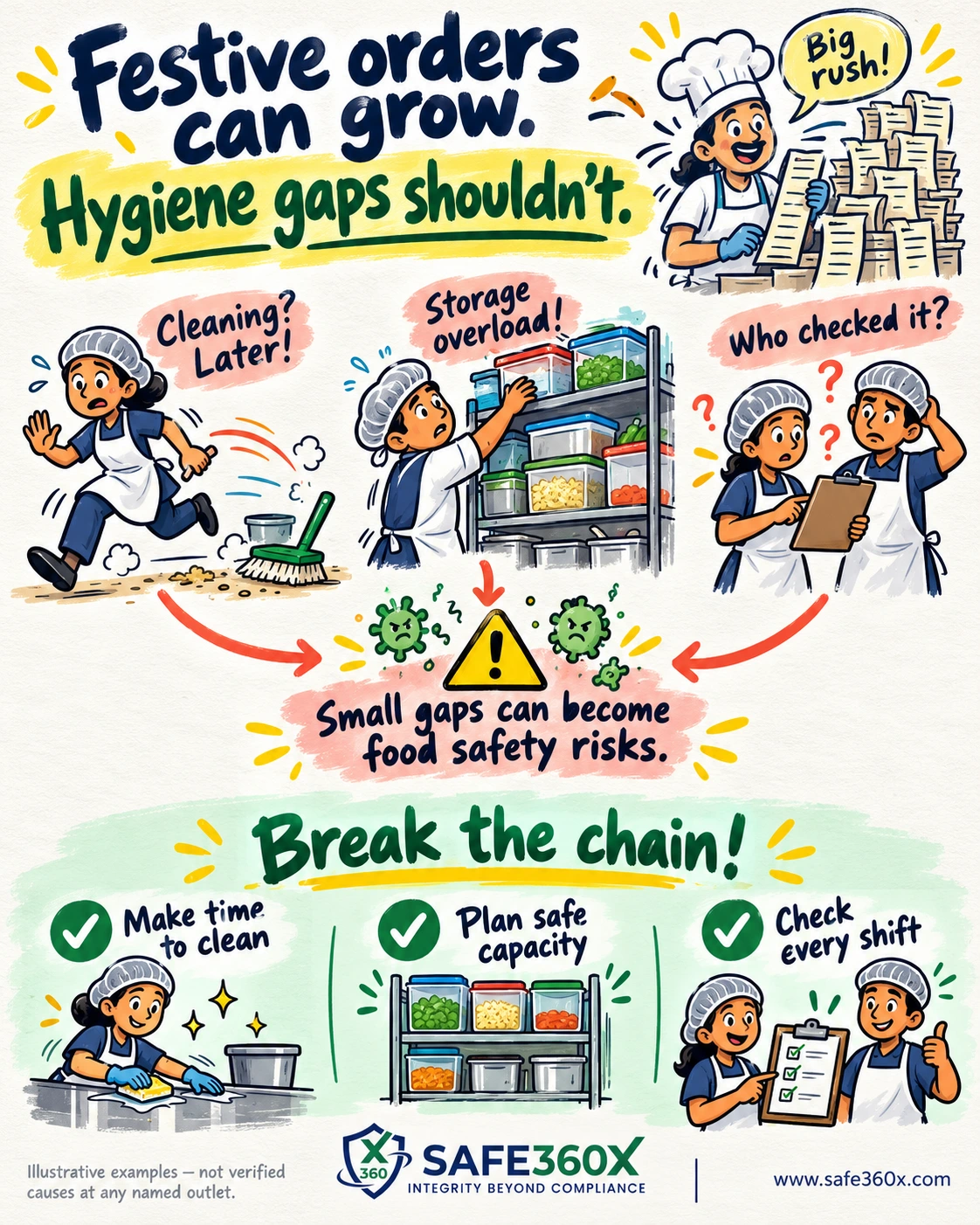
During a sales rush, the pressure is visible: more production, faster dispatch and longer shifts. The safety gaps can be less visible—behind a shelf, in an overloaded refrigerator or in a task everyone assumes somebody else completed.
Plan how much food your kitchen can safely prepare, store and deliver before accepting more orders.
What the report says—and what it does not
NDTV Food’s 28 October 2026 report describes pest findings at a Haldiram’s restaurant on Kolkata’s VIP Road. It says the operators volunteered to close for two days for corrective work, with a further inspection before reopening. The adjoining retail outlet was reported compliant.
The report does not establish that festive demand caused those lapses, and it does not provide a confirmed investigation into the causes. The examples below are possible ways problems can develop, not findings about that business. This article does not establish the outlet’s current operating status.
Why “staff were busy” is not a complete root cause
Being busy describes a condition. Ask why an important task was missed when work increased.
Was cleaning time left out of the production plan? Did the person responsible leave before a replacement was assigned? Were storage limits unclear? Did a supervisor sign a checklist without checking the area?
These are questions to investigate using evidence. Staff interviews, shift rosters, cleaning records, stock levels and direct observations may help test the explanation. Do not choose a cause simply because it sounds plausible.
1. More work, less time for cleaning
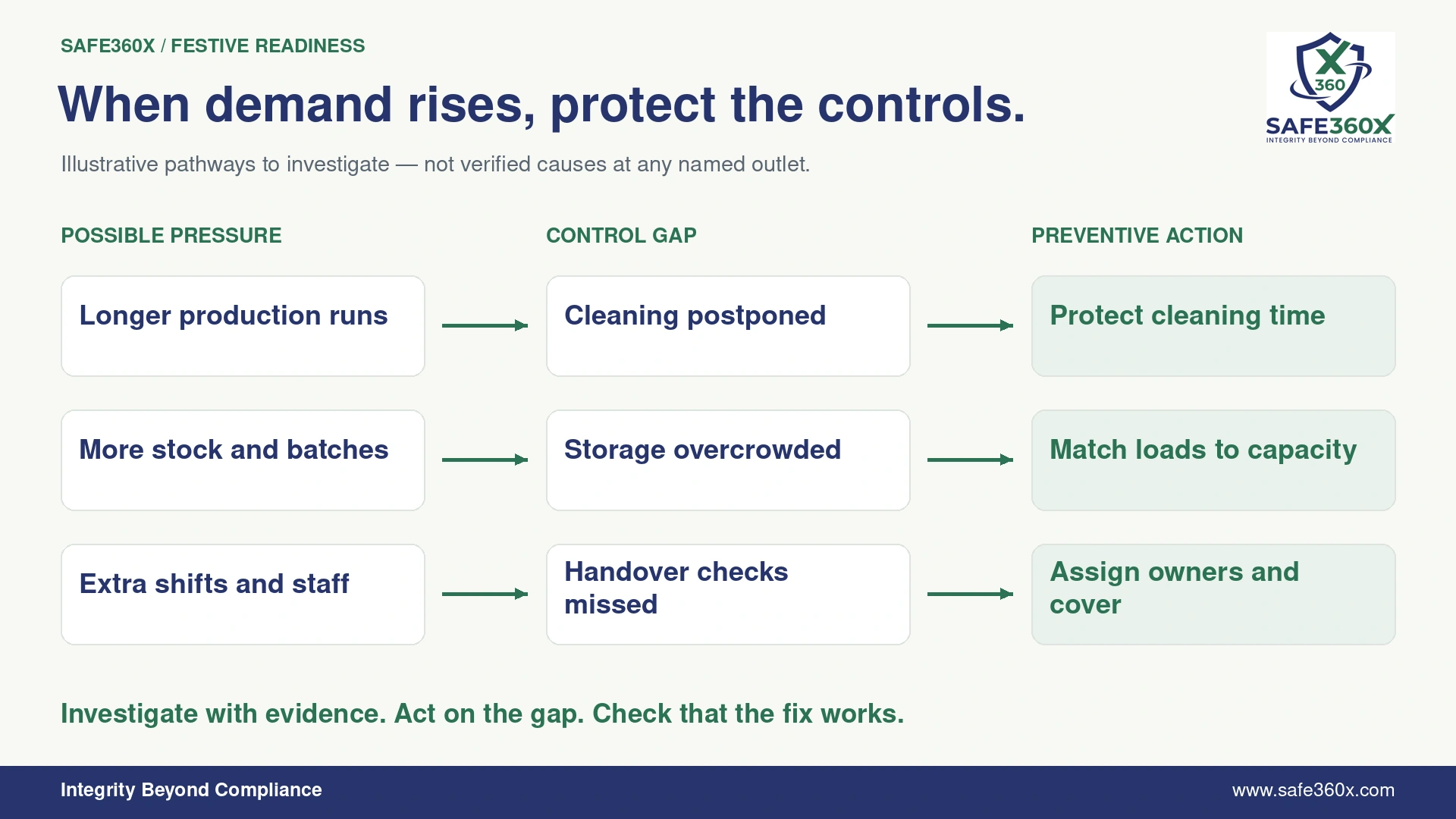
What can happen: orders increase → equipment stays in use longer → cleaning is postponed → food residues and waste accumulate → contamination and pest-attraction risks increase.
Cleaning a visible worktop may not address the undersides of shelving, equipment bases or other difficult-to-access places. A pest-control visit also cannot replace daily hygiene, waste removal and maintenance.
What to do: include cleaning access and time in the production schedule. Name the person who does the task and the person who verifies it. Review waste removal and pest observations during the shift, and investigate repeated activity rather than merely recording it.
2. More stock, less storage space
What can happen: purchasing and preparation increase → storage becomes crowded → separation or time-and-temperature checks become harder → handling and storage controls may fail.
Buying extra ingredients is not automatically a problem. The problem is accepting more than the operation can safely receive, store, prepare and dispatch.
What to do: plan deliveries and batch sizes around actual storage and processing capacity. Keep raw and ready-to-eat food separated, make date identification easy, and check product-specific storage limits. If capacity is exceeded, change the production plan or arrange suitable additional capacity before accepting more work.
3. Longer shifts, unclear responsibilities
What can happen: extra shifts or temporary workers → rushed handovers → checks have no clear owner → problems are missed or repeated.
“Someone checked it” is not a reliable handover. Staff need to know which checks are due, where results are recorded and who can stop or adjust production when a limit is not met.
What to do: give short task-specific briefings, assign responsibilities by shift and identify cover for breaks and absences. Supervisors should observe practices and inspect the work area, not rely only on completed forms.
Checks to complete before a busy period
- Orders: accept work your staff, equipment and storage can safely handle.
- Cleaning: keep enough time and supplies for cleaning, including areas behind and under equipment.
- Pest prevention: check entry points, waste and signs of pests, and act on the findings.
- Process controls: check the cooking, cooling, holding and delivery controls relevant to your products.
- Frying oil: apply a defined monitoring and replacement procedure where frying is carried out.
- People: train temporary staff, explain shift handovers and make clear who must be told about a problem.
- If something goes wrong: keep affected food separate, check its safety and fix the problem before restarting the affected work.
FSSAI’s catering inspection checklist covers pest management, waste removal, staff competence, hygiene and records. Use the checklist applicable to your activity as a starting point, then assess your own products and operations.
Respond to a failure without creating another one
When a problem is found, protect food and customers first. Identify what may be affected, stop the relevant unsafe activity and decide whether stock must be held, withdrawn or recalled. Follow applicable notification requirements and any official directions.
Coordinate pest treatment with competent personnel, protect food and food-contact surfaces, and follow the treatment provider’s and product instructions. Verify the area is suitable before resuming work. An assumed waiting period or a calendar reminder alone is not evidence that conditions are safe.
If an authority has restricted operations, reopening must follow its directions and required authorisations.
Protecting sales means protecting the operation
Strong hygiene controls need resources. They can also help reduce spoiled ingredients, discarded products, rejected deliveries and avoidable downtime.
Track those losses alongside sales. A larger order book does not help if the operation cannot deliver safely and reliably. Good food safety practices can help your business keep running reliably. They do not guarantee profit or protection from enforcement action.
How SAFE360X can support your team
SAFE360X helps food businesses assess readiness, identify gaps, investigate recurring issues, train staff and follow up on corrective actions.
Our support can include a practical review before a busy period of cleaning arrangements, storage capacity, shift responsibilities and food safety records. The business remains responsible for daily checks and putting improvements into practice.
Before increasing output, ask: what extra resources will keep our controls working?
Contact SAFE360X to discuss your kitchen’s food safety needs.
SAFE360X | Integrity Beyond Compliance