
For a restaurant owner, café operator, caterer or food manufacturer, managing compliance alongside daily operations can be challenging. FSSAI’s 2026 licensing reforms simplify some administrative requirements. Business owners should understand what has changed and what still needs their attention.
What has changed?
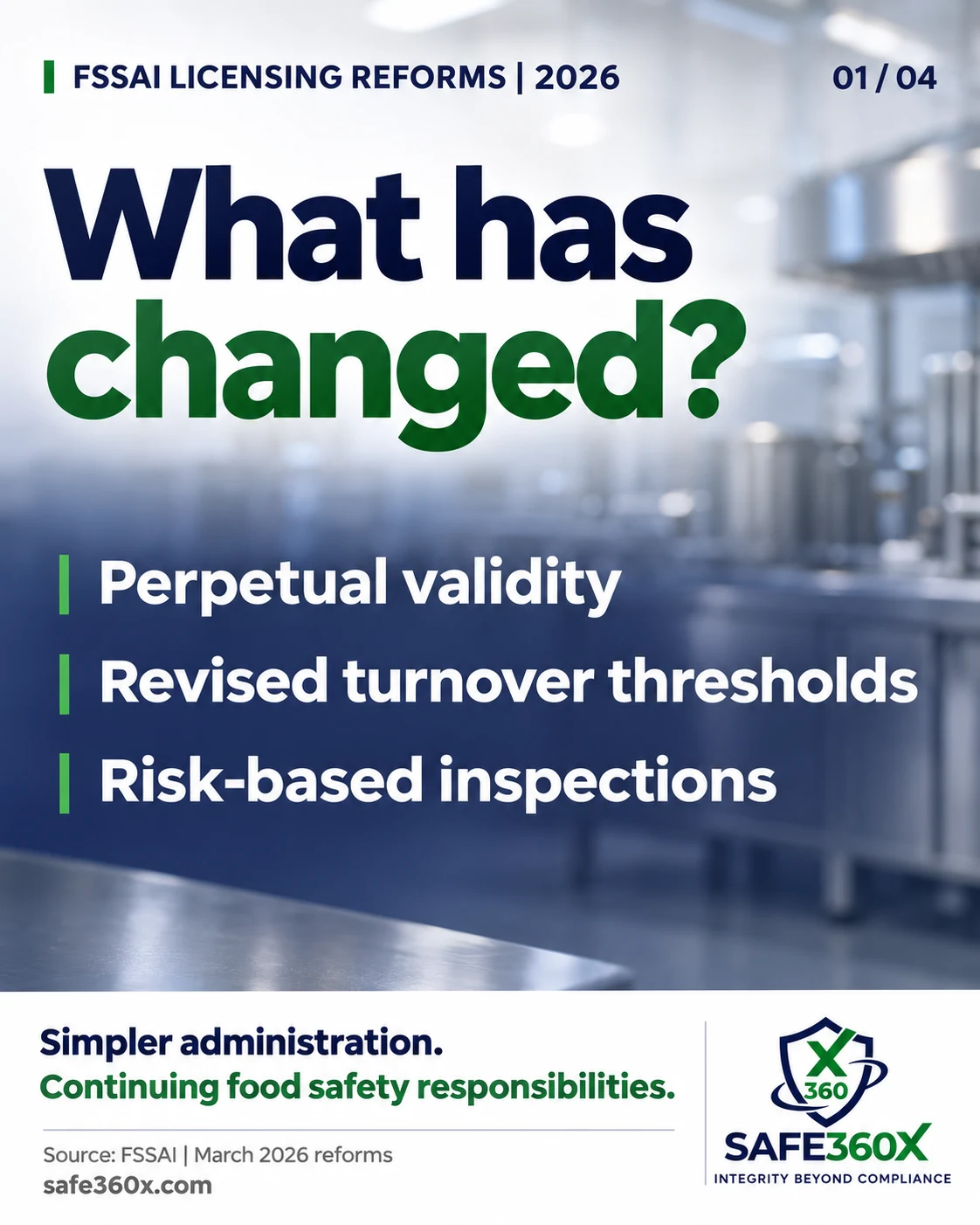
The March 2026 reforms introduced perpetual validity, revised turnover thresholds, deemed registration for eligible street food vendors and a risk-based inspection framework. These are notified reforms rather than draft proposals.
Revised turnover thresholds
The revised thresholds took effect from 1 April 2026:
- Registration: turnover up to ₹1.5 crore.
- State licence: turnover above ₹1.5 crore and up to ₹50 crore.
- Central licence: turnover above ₹50 crore.
Confirm your applicable eligibility and category through FoSCoS before applying or changing your existing status.
What does perpetual validity mean?
Licences and registrations remain valid unless suspended, cancelled or surrendered. Periodic renewal is no longer required.
However, perpetual validity does not remove applicable fees. FSSAI’s March FAQ separately addresses payment, including the option to pay for multiple years. Check the requirements shown for your business on FoSCoS.
What should existing businesses check?
The March FAQ provides for migration through FoSCoS to align existing businesses with the revised thresholds. Modifications continue through the existing procedure.
Review your certificate, FoSCoS account and current instructions before taking action. Do not surrender a licence merely because a turnover table suggests a different category. Confirm the applicable migration process first.
Daily food safety still needs daily attention
Your regulatory status is one part of compliance. Safe operations depend on what your team does during receiving, storage, preparation, production and service.
The following are practical SAFE360X recommendations for turning procedures into everyday working habits. They are not additional reforms introduced by the March notification.
1. Give cleaning clear ownership
A cleaning schedule becomes useful when employees know what to clean, when to clean it and who will check the work.
Include equipment joints, storage corners and areas below worktables. Plan cleaning time alongside production so essential tasks are not repeatedly postponed during busy periods.
2. Check how food moves through your business
Walk through the journey of ingredients from delivery to the customer. Ask where raw food could contaminate ready-to-eat food, where storage becomes overcrowded and where temperature checks could be missed.
Assign someone to act when a check identifies a problem. Use controls appropriate to your products and processes.
3. Make training practical
Employees need instructions they can apply during a real shift. Demonstrate tasks, ask staff to explain them back and observe how they work.
An attendance sheet records participation. Managers should also check whether the team follows the procedure.
4. Keep records that help decisions
Records should reflect actual checks. Avoid filling them in later from memory.
A useful record answers: what was checked, was the result acceptable, and what action followed a problem? Select records according to your activities and applicable requirements rather than collecting forms nobody reviews.
5. Follow corrective actions through
Cleaning a dirty surface addresses the immediate problem. Understanding why cleaning was missed helps prevent it from happening again.
Was responsibility unclear? Was equipment difficult to access? Were cleaning materials unavailable? Correct the underlying issue and check whether the improvement continues.
Will inspections stop?
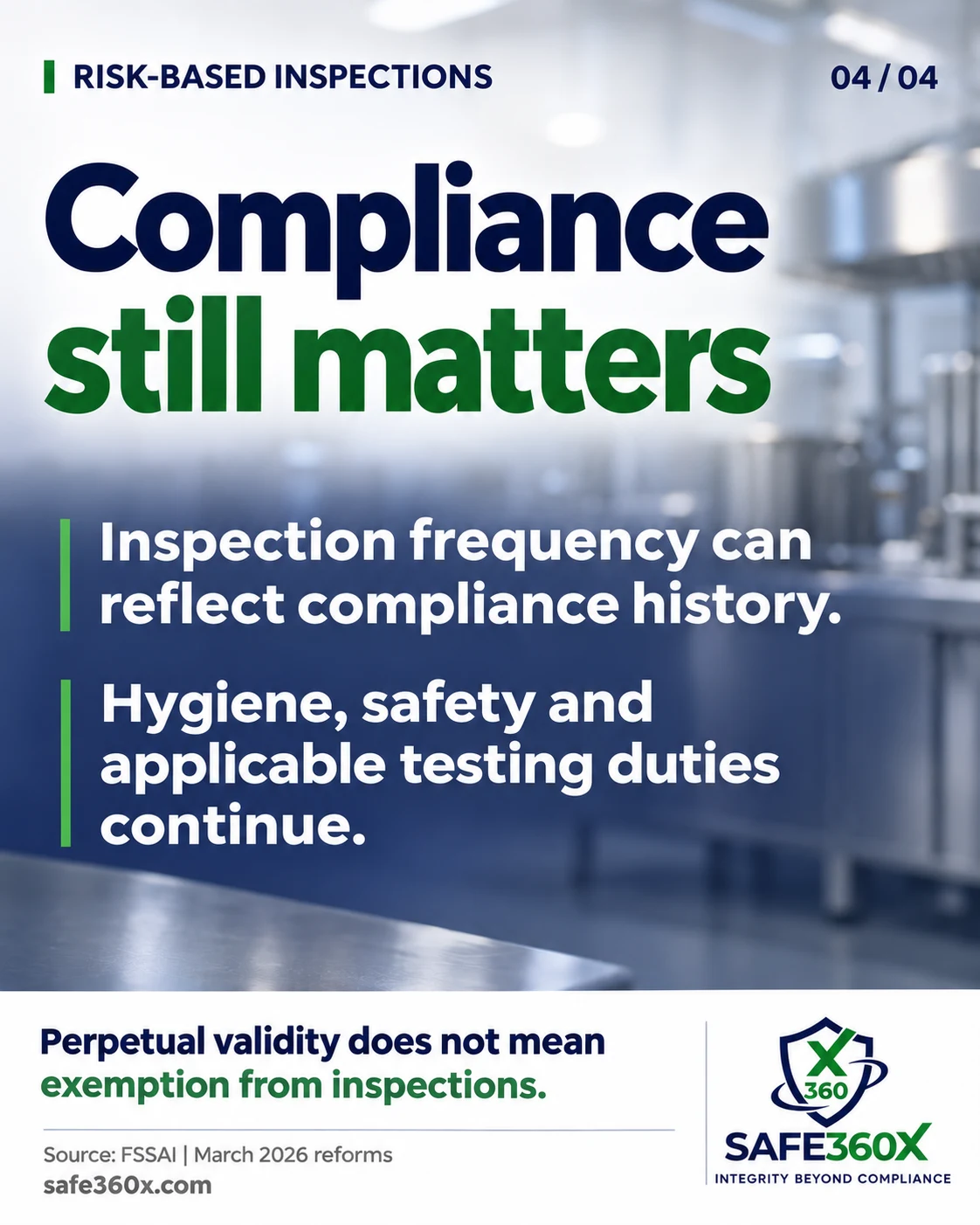
No. FSSAI describes a risk-based approach that considers compliance history and other inputs. It is not an exemption from inspection or a promise of fewer visits.
A practical review for business owners
- Is our licensing or registration status correct?
- Have we checked current FoSCoS instructions and applicable payments?
- Are procedures suitable for the work we actually do?
- Does each important task have a responsible person?
- Are supervisors reviewing checks and correcting gaps?
- Can we show that corrective actions have worked?
Use these questions as a starting point, rather than a complete legal checklist.
How SAFE360X can support your business
SAFE360X helps food businesses identify operational gaps and develop practical ways to manage them. Our support includes hygiene assessments, food safety procedures, staff training, corrective-action follow-up and food safety management system implementation.
Whether you run one café or several production sites, the aim is to make responsibilities clear and safe practices easier to maintain. The food business remains responsible for its operations and compliance.
Your licence may have continuing validity. Your food safety system needs continuing attention.
Contact SAFE360X to discuss support for your business.
SAFE360X — Integrity Beyond Compliance
Editorial review: 11 November 2026. This article explains selected March 2026 reforms and practical recommendations. Check current FSSAI and FoSCoS instructions for business-specific eligibility, payments and transition actions.