

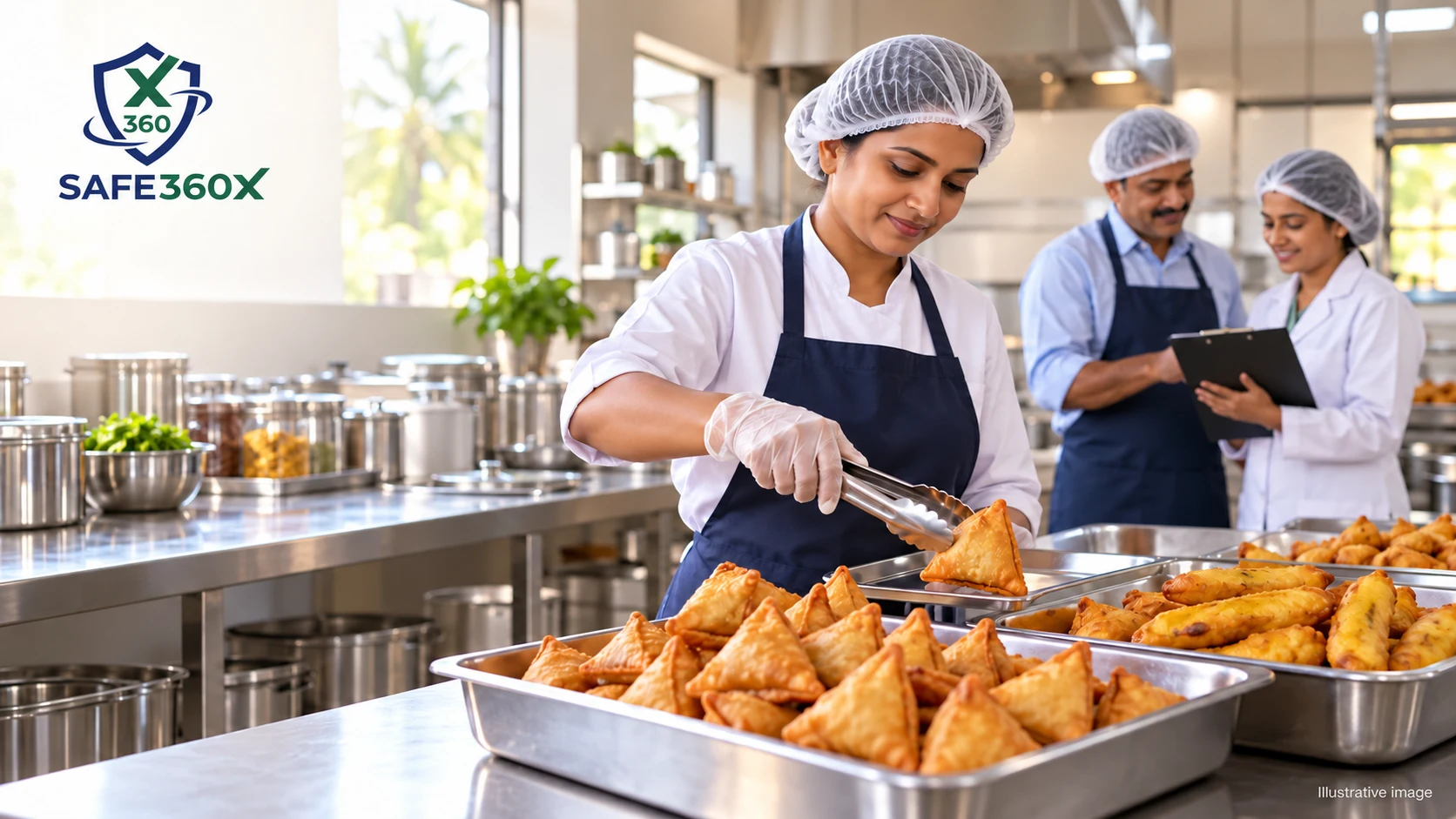
A snack business can begin with a good recipe, a small kitchen and a few regular customers. As orders grow, however, the operation becomes more demanding. More ingredients arrive, larger batches are prepared, storage fills up and deliveries become harder to coordinate.
Food safety controls need to grow with the business.
Kerala’s recent Operation Thelima inspections offer a timely reminder. According to the Kerala government’s report dated 27 October 2026, inspections of 12 bulk snack suppliers in parts of Alappuzha district resulted in ₹3.91 lakh in fines, eight registration suspensions and temporary stoppage measures. Two unregistered establishments were closed.
For businesses making samosas, fried snacks and other prepared foods, the practical question is: what should we put right before the next batch leaves our kitchen?
The following points are broader prevention guidance, rather than a description of every violation found during those inspections.
1. Make sure your permissions match your operation
Check that your FSSAI registration or licence covers your actual business activity and premises. When production expands or operations change, review whether your authorisation needs updating.
Also confirm the local-body and other permissions applicable to your establishment. FSSAI registration or licensing does not replace every other permission.
FSSAI’s Schedule 4 provides hygiene requirements for different categories of food businesses, including manufacturing and catering. Identify the requirements relevant to your operation and use the appropriate inspection checklist to assess your practices.
2. Give fillings as much attention as the finished snack
A finished samosa may look attractive while problems in ingredient handling or storage remain unnoticed.
Review the journey of chicken, vegetables and prepared fillings:
- Where do ingredients come from?
- How are they checked when received?
- How long do they wait before preparation?
- How are cooked fillings cooled and stored?
- What happens during transport and delivery?
Establish suitable time and temperature controls for the product and process. Give staff a reliable way to check them and clear instructions for responding when something goes wrong.
Frying the outer pastry should never be treated as a substitute for controlling the safety of the filling.
3. Separate raw ingredients from cooked food
Review how people, utensils and ingredients move through the kitchen.
Raw poultry and its juices should not contaminate cooked fillings or finished snacks. Hands, chopping boards, containers, cloths and worktops also need attention.
The working arrangement should make safe handling practical during busy production periods. If staff must repeatedly cross between raw and cooked work without proper controls, review the layout and sequence of tasks.
4. Make cleaning and personal hygiene part of production
Cleaning should have a responsible person, a defined method and a check that it was completed effectively.
Include equipment, food-contact surfaces, storage containers, drains and waste areas. Provide suitable handwashing facilities and supplies, and use cleaning chemicals according to their instructions.
Staff should understand how to report illness and when they should stop handling food. Training should involve observing how tasks are performed and correcting unsafe practices—not simply collecting attendance signatures.
5. Manage frying oil with a clear procedure
Oil management deserves particular attention in businesses producing fried snacks.
FSSAI states that used frying oil with Total Polar Compounds above 25% must not be used. Appearance alone cannot establish a TPC result.
Choose an appropriate monitoring method, train the person responsible and establish when oil must be removed from use. Adding fresh oil should not become a substitute for managing degraded oil.
6. Protect food until it reaches the customer
Food safety work continues after cooking.
Use suitable food-contact packaging, clean containers and transport arrangements that protect products from contamination. Establish appropriate storage and delivery conditions for the food being supplied.
Do not assign shelf life simply by copying another business. It should have a justified basis appropriate to the product, process, packaging and storage conditions.
Check the labelling requirements applicable to how your product is packed and sold.
7. Keep records that help you act
Useful records should reflect what actually happened in the kitchen.
Supplier details, production dates, batch identification and dispatch information can help answer important questions when a complaint arises: which batch was involved, what ingredients were used, and which shops received it?
Keep records simple enough for the team to maintain accurately. Review them and act on problems.
If food may be unsafe, stop dispatch, isolate affected stock and assess the necessary withdrawal, recall and reporting actions. Questionable food should never be mixed into another batch to avoid a loss.
Can better food safety support profitability?
Better controls can support business performance, although they do not guarantee profit.
Planning production around demand can reduce unnecessary batches. Stock rotation can reduce expired ingredients. Reliable storage and handling can reduce spoilage and rejected deliveries. Clear procedures can reduce repeated mistakes.
These improvements also require investment in facilities, equipment, training and supervision.
Track the results using practical measures such as:
- Ingredients and finished products discarded.
- Customer returns and repeat complaints.
- Orders rejected because of quality or safety concerns.
- Time lost to equipment failures or operational disruption.
- Repeat problems that remain unresolved.
This helps the business understand whether improvements are working. Profitability still depends on demand, pricing, costs and execution.
How SAFE360X supports food businesses
SAFE360X helps food businesses understand their gaps and turn findings into practical action.
Our support includes baseline food safety assessments, prioritised improvement plans, staff training, laboratory testing facilitation where appropriate, and follow-up verification.
We work alongside the business’s team to establish routines they can maintain during everyday production. The food business remains responsible for implementing corrective actions and managing daily controls.
Our services do not confer government approval or guarantee exemption from enforcement. The aim is to help businesses strengthen their practices, protect consumers and reduce avoidable operational risks.
Running a snack production unit, bakery or catering kitchen? Contact SAFE360X to discuss your operation.
SAFE360X | Integrity Beyond Compliance
Reviewed: 28 October 2026. Requirements depend on the business activity, product and current rules. Where an authority has issued a notice or suspension, follow its directions and obtain the required authorisation before resuming affected operations.